
What is CientIA.CSIC?
Machine translation. View original in Spanish
CientIA.CSIC is the programme through which the Spanish National Research Council (CSIC) implements its AI Strategy across all its institutes and scientific disciplines.
Access to AI models is not the only obstacle to leveraging them. The challenge for a large public research organisation is to transform rapidly evolving AI capabilities into reliable, useful, and responsible changes in scientific practice: from data analysis and simulation to reading scientific literature and designing experiments.
Objectives
- Provide research and management teams with AI infrastructure and models that ensure intellectual and data sovereignty, meaning that the organisation’s ideas and data are not shared with third parties who might exploit them for their own benefit.
- Develop the competencies of researchers, technical staff, and management personnel.
- Support teams seeking to apply AI to specific scientific problems.
- Create a knowledge community distributed across all institutes, centres, and units.
- Experiment with new ways of doing science with AI, such as Agentic Science.
The goal is not merely to deploy AI technologies, but to create the organisational conditions for their effective adoption: competencies, data, infrastructure, evaluation, governance, security, and organisational change.
How it is organised
CientIA.CSIC is structured around four elements that form a continuous cycle of improvement: each iteration feeds the lessons learned into the next.
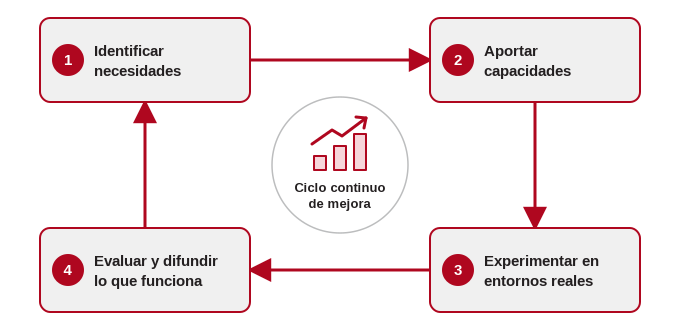
- Understanding needs and opportunities. Work is carried out directly with institutes and scientific communities to identify use cases, existing capabilities, data, obstacles, and training needs. This effort is primarily led by the AI Champions Network.
- Providing common capabilities. CSIC develops shared AI services and resources that would be costly for each institute to build independently: supercomputing and scientific computing, the CSIC LLM Service, methodological resources, and reusable tools.
- Supporting adoption. Training, methodological support, and consulting from CientIA.CSIC Acompaña help teams move from experimentation to integrating AI into their scientific workflows.
- Experimenting, learning, and scaling. Pilot projects test AI on real scientific problems, such as those in Agentic Science. A distributed network of AI Labs and local AI contacts in the institutes, together with the AIHub, helps share experience, identify best practices, and extend them across the organisation. This is complemented by the talent brought in by the Momentum Programme.
A testbed for public research
Given that CSIC covers a very wide range of disciplines and institutes, CientIA.CSIC also serves as a large-scale institutional testbed for AI adoption in public research. It allows for the study of which support mechanisms, infrastructures, and governance models truly help in researching with AI.
The lessons learned can extend beyond CSIC: they can inform the design of research and innovation policies, shared AI infrastructures, and responsible AI adoption strategies in other research organisations and the public sector.
Ultimately, the aim is to move from individual and dispersed use of AI tools to a coordinated institutional model, where AI becomes part of the scientific infrastructure and contributes to better research, better evidence, and better public decisions.
CSIC AI Strategy 2025–2030
CientIA.CSIC implements the CSIC Artificial Intelligence Strategy 2025–2030 (EstrategIA CSIC, in PDF). It is the institutional plan for CSIC to become a reference in the use and development of AI applied to science, management, and knowledge transfer. It relies on CSIC’s critical mass, with more than 18,000 professionals and 124 centres, its presence across the entire territory, and its multidisciplinary nature.
The strategy is based on a diagnosis that highlights these strengths and points out weaknesses such as fragmentation in AI use, limited staff training in digital competencies, and limited exploitation of scientific data. It has a dual vision, “science for AI” and “AI for science”, and aligns with the Spanish Government’s 2024 AI Strategy and the European RAISE initiative. All its actions are guided by an ethical commitment to honesty, respect, reliability, and responsibility.
Axes
The strategy is organised into four strategic axes and four enabling axes, which group 19 lines of action for 2025–2030.
Strategic axes
- AI & Science: promote multidisciplinary research in AI, apply AI to research and science management, and create a specialised language model for science.
- AI & Transfer: accelerate applied AI research projects and foster entrepreneurship.
- AI & Management: implement a generative AI platform for scientific management and decision-making, and streamline administrative processes with AI.
- AI Ecosystem: generate evidence on the impact of AI, promote an AI Roundtable of the Spanish scientific, technological, and business system, and create a Science Data Space.
Enabling axes
- Learning: promote training and access to information to adopt AI throughout the institution, and train a new generation of professionals with AI competencies.
- Talent attraction and retention: reinforce CSIC with scientific-technical staff for AI projects and attract external personnel to lead disruptive research lines.
- Infrastructure: strengthen the Scientific Computing Unit, expand supercomputing, and complete CSIC’s integration into the Spanish Supercomputing Network.
- International projection and institutional leadership: participate in international research programmes and in networks and platforms of excellence.
Governance
It is coordinated by the Vice-Presidency for Scientific and Technical Research (VICYT), together with the other vice-presidencies and the General Secretariat. The AIHub is the instrument that aggregates CSIC’s AI activity and executes many of the actions. The strategy foresees indicators to monitor progress and a working group on ethics and AI, together with the CSIC Ethics Committee, which will develop good practice guidelines.